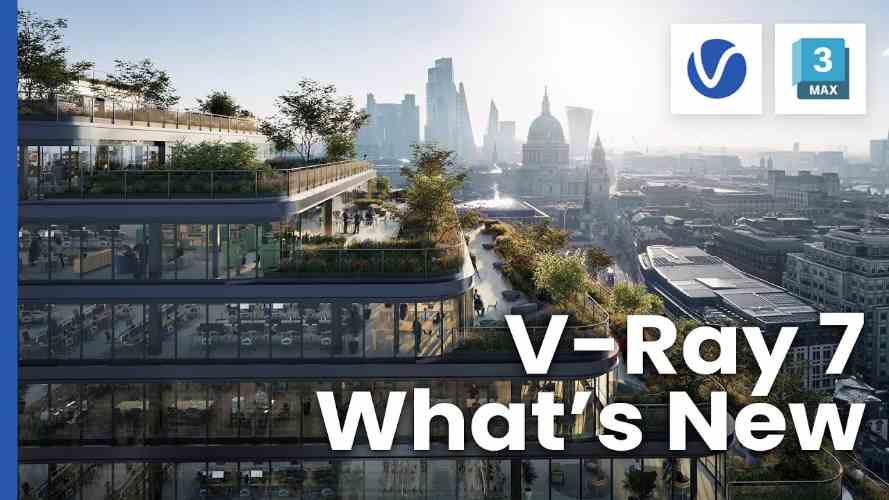
Chaos V-Ray 7.50 for 3Ds Max 2023/2024/2025/2026/2027 Full Version Free Download for Windows
Chaos Group V-Ray 7.50 is a professional rendering engine for Autodesk 3ds Max, designed for photorealistic rendering, architectural visualisation, visual effects, animation, and product design. Developed by Chaos, V-Ray combines physically based lighting, advanced materials, GPU acceleration, and extensive rendering controls to produce high-quality images and animations.
V-Ray 7.50, officially known as V-Ray 7, Update 5, introduces several improvements to volumetric rendering, lighting, GPU performance, and AI-assisted workflows. The update adds a new V-Ray Volume object, Volume Shader, Volume Textures, native V-Ray Spotlight, and Cylinder Light. It also introduces an initial implementation of the Chaos AI Assistant directly inside the rendering application.
Designed for professional 3D artists and visualisation studios, V-Ray 7.50 for 3ds Max provides an extensive set of tools for creating realistic environments, complex materials, atmospheric effects, and production-ready renders.
V-Ray 7.50 New Features
The fifth update to V-Ray 7 introduces several additions aimed at improving lighting control, volumetric effects, and scene management.
V-Ray Volume Object and Volume Shader
One of the most significant additions in V-Ray 7.50 is the initial implementation of the V-Ray Volume object and its associated volume shading tools.
The new VRayVolume object allows artists to import and render OpenVDB files and animated volume sequences directly within 3ds Max. This makes it easier to work with simulation data without repeatedly converting or rebuilding volumetric effects.
The new VRayVolumeMtl material provides controls for shading volumetric effects, including density, smoke, temperature, and emission properties.
Two additional texture nodes, VRayVolumeFloatSampler and VRayVolumeColorSampler, allow users to sample numerical and colour information from volumetric data.
These features are particularly useful for creating realistic smoke, fire, explosions, and other atmospheric effects.
tyFlow Inferno Volumetric Support
V-Ray 7.50 introduces support for the new volumetric data generated by tyFlow Inferno.
This integration allows artists to work with simulation-based smoke and fire effects directly within their V-Ray rendering workflow.
Instead of relying on complicated conversion procedures, users can bring supported volumetric simulation data into V-Ray and render it with the appropriate volume shading controls.
This is particularly useful for visual effects artists working with destruction sequences, fire simulations, explosions, and cinematic environmental effects.
Chaos AI Assistant
V-Ray 7.50 introduces the initial implementation of the Chaos AI Assistant directly inside the V-Ray interface.
The assistant provides context-aware guidance and helps users perform different tasks throughout the visualisation workflow.
Its capabilities include:
- Sky Match: Analyse reference images and suggest matching HDRIs and colour grading LUTs for scene lighting.
- Asset Recommendations: Discover relevant 3D models and materials from Chaos Cosmos based on visual references.
- Render Critique: Analyse rendered images and provide structured feedback on composition, lighting, and photorealism.
- Technical Assistance: Access contextual guidance and information about V-Ray tools and workflows.
The AI Assistant is designed to reduce repetitive work while allowing artists to retain control over their creative decisions.
New V-Ray Spotlight
V-Ray 7.50 introduces a dedicated VRaySpotLight object for Autodesk 3ds Max.
Unlike workflows that require modifying other light types to produce spotlight effects, the new light provides a dedicated source for creating focused illumination.
It includes controls for light direction, shadow radius, light linking, atmospheric contribution, and beam shaping.
The spotlight also supports barn door controls, allowing artists to restrict and shape the projected light.
This is useful for architectural interiors, stage lighting, product presentations, and cinematic scenes requiring controlled directional illumination.
Cylinder Light
The new Cylinder Light provides a physically based lighting source designed to simulate tube lights, fluorescent fixtures, and other cylindrical illumination systems.
Users can adjust the light’s length and radius to control its shape and illumination.
It supports realistic light falloff, soft shadows, and integration with LightMix, making it useful for architectural lighting and product visualisation.
V-Ray GPU Rendering Improvements
V-Ray 7.50 also introduces several improvements to GPU rendering using CUDA and RTX.
The update improves GPU sampling to make rendering behaviour more reliable and less prone to errors. Light Cache updates during Interactive Production Rendering (IPR) are also smoother.
Additional improvements include:
- Improved 2D displacement rendering.
- Better consistency between CPU and GPU Gaussian Splat rendering.
- Velocity data support for Gaussian Splats.
- VRayMatteShadowsRE support in GPU rendering.
- Frame completion time reporting for V-Ray GPU.
- Optimised GPU sampling behaviour.
These improvements make V-Ray GPU a more capable option for artists who prefer GPU rendering in 3ds Max for interactive previews and final rendering workflows.
V-Ray Frame Buffer Improvements
The V-Ray Frame Buffer (VFB) receives additional improvements in Update 5.
The update introduces automatic file-path remapping in the Image layer, helping users manage image references when working with projects moved between different locations.
Post-processing performance is also optimised, reducing unnecessary processing overhead during rendering.
The update additionally addresses an issue where Interactive Production Rendering with Light Cache denoising could display noisy images.
Existing V-Ray 7 Features
V-Ray 7.50 builds upon the broader feature set introduced throughout the V-Ray 7 release cycle.
Some notable capabilities include:
- Gaussian Splats: Integrate reconstructed real-world environments into 3D scenes.
- AI Material Generator: Create PBR materials from reference photographs.
- Chaos Scatter Clusters: Organise and distribute grouped objects using procedural scattering.
- Quick Caustics: Generate realistic light patterns through water and transparent materials.
- Parallax Interiors: Simulate interior depth behind windows without modelling complete rooms.
- Chaos AI Enhancer: Improve the appearance of people and vegetation in architectural renders.
- Distributed Rendering 2: Distribute rendering workloads across multiple machines.
- V-Ray Profiler: Identify rendering bottlenecks and analyse scene performance.
- V-Ray Luminaire: Render supported lighting fixtures using precomputed light fields.
Together, these tools make V-Ray a comprehensive photorealistic rendering engine for 3ds Max, supporting architectural visualisation, product rendering, animation, and visual effects.
Applications and Production Workflows
V-Ray is used across several professional 3D production environments.
- Architectural Visualisation: Create realistic interiors, exteriors, lighting studies, and building presentations.
- Product Rendering: Produce detailed product images with physically accurate materials and reflections.
- Visual Effects: Render smoke, fire, explosions, volumetric simulations, and complex environments.
- Automotive Visualisation: Create realistic vehicle renders with detailed surface reflections and lighting.
- Motion Graphics: Produce animated sequences with advanced materials, lighting, and atmospheric effects.
- Interior Design: Present furniture, materials, lighting arrangements, and decorative elements.
Its combination of CPU and GPU rendering makes it suitable for different production requirements and hardware configurations.
System Requirements and Compatibility
V-Ray 7.50 for 3ds Max is available for Windows-based workstations running compatible versions of Autodesk 3ds Max.
| Component | Requirement |
|---|---|
| Rendering software | V-Ray 7.50 (Update 5) |
| Host application | Autodesk 3ds Max |
| 3ds Max compatibility | 2022–2027 |
| Operating system | Windows 10 or newer |
| CPU rendering | Supported 64-bit Intel and AMD processors |
| GPU rendering | Compatible NVIDIA CUDA/RTX hardware |
| Rendering modes | CPU and GPU |
| Licensing | Chaos subscription |
The compatibility range is based on the official Update 5 release announcement. The supplied product title covers 3ds Max 2023–2027, which falls within this range.
Important: V-Ray 7 Update 5 introduces API changes that may require updates to third-party plugins. Older versions of certain third-party plugins may crash when used with this release. Users should verify compatibility with tools such as tyFlow, Forest Pack, and RailClone before upgrading.
Licensing and Subscription
V-Ray is distributed through Chaos subscription plans rather than a traditional perpetual licensing model.
Available plans include V-Ray Solo and V-Ray Premium, while V-Ray Collection provides access to additional Chaos products and visualisation tools.
The included applications, asset libraries, AI capabilities, and additional services vary according to the selected subscription.
Chaos also offers a free trial for users who want to evaluate V-Ray before purchasing a licence.
For current subscription pricing, trial access, installation information, and licensing details, visit the official Chaos V-Ray for 3ds Max website.
Conclusion
Chaos Group V-Ray 7.50 for 3ds Max introduces important improvements to volumetric rendering, lighting, GPU performance, and AI-assisted workflows.
The addition of the V-Ray Volume object, Volume Shader, tyFlow Inferno support, native Spotlight, and Cylinder Light expands the rendering engine’s capabilities for both architectural visualisation and visual effects production.
Combined with existing V-Ray 7 features such as Gaussian Splats, AI Material Generation, Chaos Scatter, Distributed Rendering 2, and the V-Ray Frame Buffer, the update provides a comprehensive environment for professional 3D rendering.
For architectural visualisation artists, product designers, motion graphics professionals, and VFX artists, V-Ray 7.50 for 3ds Max offers an extensive collection of tools for producing realistic images, animations, and complex visual effects.
V-Ray 7.50 features
Photorealistic rendering engine for 3ds Max
GPU rendering in 3ds Max
3ds Max rendering plugin
V-Ray volumetric rendering
V-Ray AI Assistant
V-Ray for architectural visualisation
V-Ray 7 Update 5
Chaos V-Ray 7.50 for 3Ds Max 2023/2024/2025/2026/2027 Full Version Free Download for Windows
https://zeroupload.com/4c338b100a9984e6e0402a5e710d6bba
https://filekeeper.net/rdf39u7rhek4/VRay7.503DM_DownloadPirate.com.rar