AEScripts MotionStack v1.0 for After Effects Script WIN/MAC Full Version Free Download
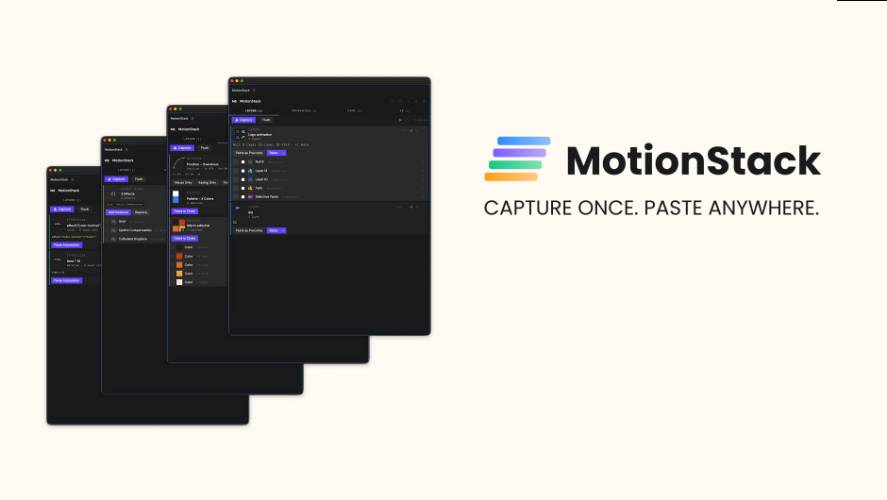
AEScripts MotionStack v1.0 is a persistent visual clipboard for Adobe After Effects. It is designed for the pieces of motion-design work that you want to reuse during a project but don’t necessarily want to turn into permanent presets.
Instead of After Effects’ normal clipboard, which effectively remembers only the latest thing you copied, MotionStack lets you build a visual collection of layers, keyframes, expressions, effects, colour palettes and text and paste them back into other compositions when needed.
AEScripts MotionStack official page
What is MotionStack?
MotionStack is essentially a working-memory system for After Effects.
Imagine you’ve just created a really nice bounce animation. You know you’re going to use it three more times today, but you don’t want to save it as a formal preset. With MotionStack, you capture it as a card and keep it available in the panel.
The same idea works for an expression you just wrote, an effect stack, a colour palette or a piece of text.
It’s deliberately positioned between the normal clipboard and a permanent preset library.
Four Types of Stacks
MotionStack divides captured content into four main categories: Layers, Properties, Expressions and FX.
The Layers section can capture complete layer setups including timing, parenting, mattes, masks, effects and transform information. Properties can contain keyframes, easing, static values, masks, palettes and text. Expressions are stored as expression strings, while FX captures effect stacks together with their values, enabled states and keyframed parameters.
This separation is useful because each type of content has different requirements when you paste it back into a project.
Capture Complete Layer Rigs
The Layers stack is probably the most powerful part of MotionStack.
You can capture a layer or group of layers and retain things such as parenting, mattes, masks, effects, transforms and timing. The captured layers can then be pasted into another composition.
MotionStack uses a hidden composition called MotionStack.internal inside the project to preserve the captured layers using After Effects’ own copy mechanism. According to the developer, this is what allows the paste to retain things such as easing, mattes and footage links rather than rebuilding the layer from scratch.
Properties and Keyframes
You can also capture individual properties rather than an entire layer.
This is useful when you’ve created a particular animation curve that you want to reuse elsewhere.
For example, you might have a carefully tuned scale animation with specific easing. Instead of copying an entire layer just to get that animation, you can capture the property and paste it onto another layer.
Static values, keyframes, easing and masks can all be stored as property cards.
Expressions
Expressions can be stored separately as cards.
This is particularly useful for expressions that you repeatedly use during a project but don’t want to maintain as a formal expression library.
MotionStack also provides reference warnings when an expression depends on context that may not exist in the destination. That is important because simply copying an expression isn’t enough if it references a specific layer, composition or property.
Effect Stacks
MotionStack can capture entire effect stacks, including effect parameters, enabled states and keyframed values.
This makes it useful when you’ve developed a particular combination of effects and want to apply the same treatment elsewhere.
Third-party effects are supported as long as the required plugin is installed on the destination machine. MotionStack stores the internal effect match name and parameter values, while After Effects handles the situation normally if the destination system doesn’t have the required plugin.
Text and Colour Palettes
MotionStack isn’t limited to animation data.
You can paste plain text, hexadecimal colour values and expression snippets into the panel, and MotionStack automatically routes them into the appropriate section.
That makes it surprisingly useful for general motion-design work.
You might have a colour palette from a reference frame, a title you need to reuse or a small expression snippet you just wrote. Instead of leaving these scattered across notes, screenshots or your system clipboard, they can remain visible alongside your other project assets.
Persistent Clipboard
The main difference from After Effects’ normal clipboard is persistence.
With the normal clipboard, you copy something, copy something else, and the first item is effectively gone.
MotionStack keeps multiple captured items visible in its stack, so you can switch between them and paste whichever one you need.
This is especially useful during repetitive production work.
Pin Important Cards
Cards can be pinned so they survive stack flushes and remain visible across projects.
This gives MotionStack two different levels of storage.
Temporary cards can exist for the duration of a project or work session, while pinned cards can act more like frequently used personal tools.
That makes it possible to keep a few favourite animation rigs, expressions or effect combinations permanently available without turning the entire stack into a huge preset library.
Paste as Precomp
MotionStack can also paste captured layer groups as a precomp when keeping the group contained is the cleaner workflow.
This is useful because sometimes you want the layers exposed directly in the destination composition, while other times you want to bring the entire setup across as a self-contained unit.
Automatic Warnings
MotionStack includes practical warnings when a captured setup depends on things that may not exist in the destination.
For example, missing parents, track mattes and references can be surfaced before they become confusing problems.
This is particularly important when transferring more complicated rigs between compositions.
A simple keyframe doesn’t have many dependencies. A multi-layer rig can have a lot.
Export and Import
Although MotionStack is primarily designed around temporary working memory, useful stacks can be exported when they become worth keeping.
Property, expression and effect cards can be exported and imported between projects or machines. Layer cards work differently because their captured contents live inside the hidden MotionStack.internal composition of the source project.
This distinction is important if you’re planning to use MotionStack as a long-term asset library.
It’s primarily a session and project workflow tool, not a replacement for a traditional preset manager.
Project-Specific Stacks
When you open another After Effects project, MotionStack switches to that project’s stack.
Cards are scoped to the project, while pinned cards remain visible across projects.
This prevents the panel from becoming a giant dumping ground containing every piece of motion you’ve ever captured.
It’s designed around the work you’re currently doing.
Crash Protection
MotionStack writes captured card data immediately when you capture something. The storage location can be configured in Settings on macOS or Windows.
That means a crash shouldn’t wipe out everything you’ve captured during the session.
It’s a small feature, but for a tool whose entire purpose is remembering temporary work, it’s an important one.
Workflow Example
A typical MotionStack session could look like this:
You create a nice bounce animation for a logo. You capture the layer rig and continue working.
Later, you create another composition and need the same movement. Instead of going back to the original composition and copying the layer, you open MotionStack and paste the captured rig.
Then you create a colour palette for the project and capture that too. You write a useful expression, capture it as another card, and save an effect stack you’re likely to use again.
None of these things needs to become a permanent preset.
That’s exactly the gap MotionStack is trying to fill.
MotionStack vs After Effects Clipboard
After Effects’ native clipboard is perfectly adequate when you need to copy something once.
MotionStack becomes useful when you’re repeatedly switching between several pieces of content.
The difference is essentially:
Native Clipboard: copy → paste → replace with next copy.
MotionStack: capture → keep several cards → choose what to paste whenever you need it.
That sounds like a small difference, but it can save a surprising amount of unnecessary navigation during a busy project.
MotionStack vs Preset Libraries
MotionStack also occupies a different position from a traditional preset library.
A preset is something you’ve deliberately decided to save and maintain.
MotionStack is for things that are useful right now.
That distinction is actually quite smart. Not every useful animation deserves a permanent preset with a carefully chosen name and folder structure.
Sometimes you simply want to reuse something for the next ten minutes.
Who Should Use MotionStack?
Motion designers are the obvious audience, especially those who frequently reuse small animation systems, effects or expressions across multiple compositions.
It’s also useful for freelancers and production artists working through revisions because temporary animation decisions can remain accessible without cluttering the project with unnecessary presets.
For template creators, the layer and property capture functionality can also be useful when moving reusable structures between compositions.
If your After Effects workflow is mostly one-off editing with little reuse, MotionStack probably won’t make a dramatic difference.
Compatibility
MotionStack v1.0 was released on August 19, 2026. The official AEScripts listing currently supports After Effects 2022, 2023, 2024, 2025, 2026 and 2027.
It runs on both macOS and Windows, including Intel and Apple Silicon systems. The plugin is distributed as a signed ZXP and can be installed through the aescripts + aeplugins Manager App or the ZXP Installer.
The regular listed price is $35, with a promotional price of $26.99 through September 4, 2026. A free trial is available.
Final Thoughts
MotionStack v1.0 is one of those productivity tools that makes sense once you understand the problem it is solving.
It’s not another animation preset pack. It’s not another effect. It’s essentially a persistent visual clipboard for After Effects.
The ability to temporarily store complete layer rigs, properties, expressions, effect stacks, colours and text makes it particularly useful during production, when you’re constantly creating small pieces of work that you’ll need again but don’t want to formally archive.
The distinction between temporary stacks and pinned cards is also well thought out. You can keep today’s working material separate from the few things you genuinely want available across projects.
For someone who does a lot of motion design, the biggest benefit is simple: less going back, less rebuilding and less digging through old compositions.
Bottom line: MotionStack is basically a proper working memory for After Effects, and at $26.99 on its current introductory price, it’s a pretty compelling workflow utility for heavy AE users.
AEScripts MotionStack, MotionStack After Effects, MotionStack v1.0, After Effects visual clipboard, After Effects persistent clipboard, After Effects workflow tool, After Effects layer clipboard, After Effects animation clipboard, After Effects keyframe library, After Effects expression library, After Effects effect stack, After Effects motion design workflow, After Effects productivity tool, After Effects animation workflow, After Effects copy paste tool
AEScripts MotionStack v1.0 for After Effects Script WIN/MAC Full Version Free Download
https://zeroupload.com/a90a85ca9f09d743c493d059e05af786
https://buzzheavier.com/4l2g9sgda41b
https://pixeldrain.com/u/2gzSqJmC
https://filekeeper.net/znd3rc38uizl/MotionStack1.0_DownloadPirate.com.zip